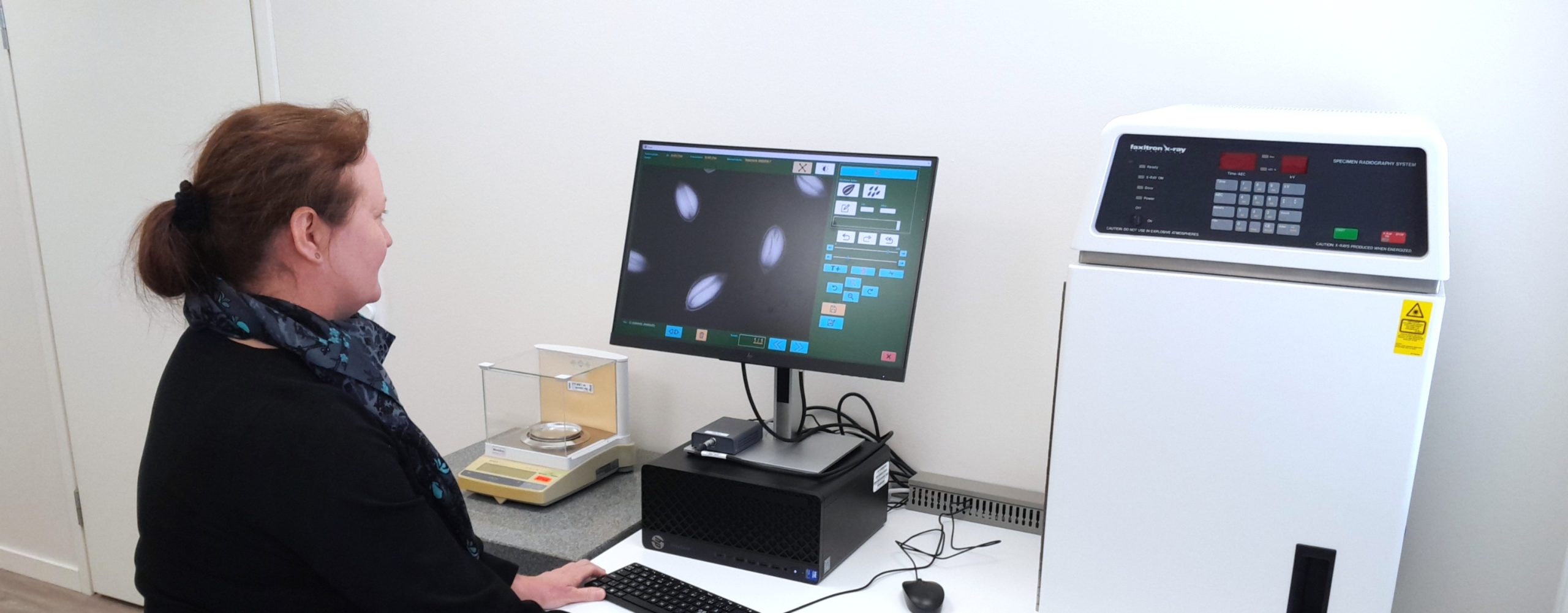
What if the quality of a seed could be determined in minutes instead of weeks? At the Oitti seed laboratory, a newly introduced X-ray imaging method is transforming how the future of forests is assessed – directly from inside the seed.
For years, research work at the Oitti seed laboratory has been highly manual and detail-oriented. The future of forests depends on small things — quite literally on seeds — and assessing their quality has traditionally been slow and time-consuming.
“We produce forest tree seeds for reforestation purposes, supplying them to nurseries, forest companies and forest owners’ associations,” says Susanna Rantakari, Seed Production Specialist at Tapio Palvelut Oy. Tapio Palvelut is one of Finland’s two forest seed producers and accounts for nearly half of the country’s seed production.
Traditionally, seed quality has been analyzed using microscopes and germination tests. The work requires both time and manual effort – a single analysis can take weeks.
“For example, germination testing alone takes two to three weeks,” Rantakari explains.
At the same time, operating conditions have changed. Longer autumns and warmer periods make it more difficult to assess seed maturity. The need for faster and more precise information has increased.
X-ray imaging makes the inside of the seed visible
At the beginning of 2026, a new approach was introduced at the Oitti laboratory: X-ray imaging of seeds. Innomentarium’s SeediX solution enables the internal structure of a seed to be examined without physically handling it. Instead of cutting and preparing individual seeds, they can now be analyzed as images – quickly and systematically.
“X-ray imaging makes it much more concrete what has happened inside the seed,” Rantakari notes.
Imaging does not simply replace previous methods – it changes how the work is done. Seed development can now be monitored from late summer onwards, enabling more confident decisions on optimal collection timing. During winter, it is also possible to assess frost damage affecting seed viability.
“Seeds are small, and handling and cutting them is slow work. With X-ray imaging, the analysis is now much faster,” she adds.
Data, not just samples
The new technology does more than produce images: it introduces a new way of understanding seed quality. Imaging makes it possible to compare samples, identify defects and recognize development stages in a way that was not previously as systematic.
The next step is no longer just imaging, but interpretation. AI-based analysis is seen as a promising tool, provided it is based on sufficiently large and well-validated datasets.
“AI is a useful tool, but someone still needs to train it,” Rantakari points out.
A smooth start to adoption
Introducing new technology can often be a barrier. At the Oitti seed laboratory, however, the adoption of X-ray imaging was exceptionally smooth.
“The implementation together with the Innomentarium team was even surprisingly easy, and both the instructions and the collaboration have been very clear,” says Rantakari.
“The system has also been easy to return to after breaks, which is important in seasonal work,” she adds.
Small seeds, far-reaching impact
Forest growth, carbon capture and the forests of the future all begin with a single seed. When there is better visibility into seed quality, the impact extends across the entire value chain.
What previously required time and manual work can now be seen in a single image. And sometimes, that alone is enough to support better decisions.